
Nazario Martín is Full Professor of Organic Chemistry at the UCM and Deputy Director of the new IMDEA-Nanoscience Institute of the Community of Madrid. He has been visiting professor at the universities of California in Santa Barbara (UCSB) and Los Angeles (UCLA) and at the universities of Angers and Strasbourg (France). He is Doctor Honoris Causa by the Universities of Havana (Cuba, 2012) and Castilla-La Mancha (Spain, 2016). Prof. Martín's research covers different topics with special emphasis on the chemistry of carbon nanostructures such as fullerenes, carbon nanotubes, graphene and carbon quantum dots, molecular wires, and electroactive molecules in the context of electronic transfer processes, applications in photovoltaics, chirality and nanoscience. He has directed 45 Doctoral Theses and is co-editor of 6 books and 14 special issues in prestigious international journals. He has been General Editor of the journal Anales de Química (2000-2005), member of the editorial committee and international advisory of the journals: Journal of Materials Chemistry (2000-2006), Chemical Communications (2006-2011), ChemSusChem (2011-2015) and he has been Regional Editor for Europe of the journal Fullerenes, Nanotubes and Carbon Nanostructures. He has been until recently (2019) a member of the editorial board of the journals: The Journal of Organic Chemistry and Accounts of Chemical Research (ACS). Currently he belongs to the international advisory board of ChemPlusChem, Chemistry-An Asian Journal and ChemNanoMat (Wiley-VCH) and member of the advisory board of the journals Chemical Society Reviews and Chemical Communications (RSC). He is editor of the Scientific Reports journal of the Nature Publishing group. In 2015-2019 he has been Editor-in-Chief of the Journal of Materials Chemistry (A, B and C) of the Royal Society of Chemistry.
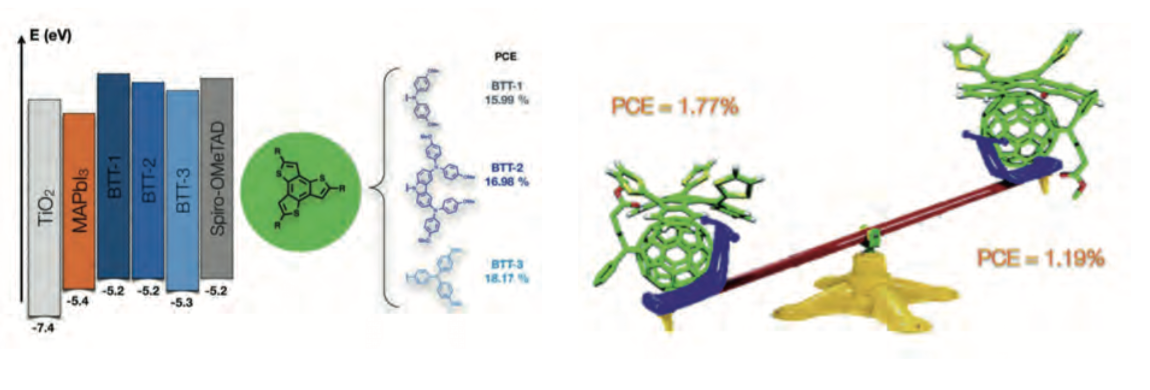
The research interests at the Prof. Martín’s group span a range of targets with emphasis on the molecular and supramolecular chemistry of carbon nanostructures such as fullerenes, carbon nanotubes and graphene, p-conjugated systems as molecular wires and electroactive molecules, in the context of electron transfer processes, photovoltaic applications and nanoscience. In particular, the group is currently engaged in:

Sara Abdollahzadeh Ghom received her PhD in nanoscience from University of Barcelona in 2012. Since then, she has been involved in teaching and research. Currently, she is a researcher in ¨Nanocarbons and organic Photovoltaics¨ member of Prof. Nazario Martín Group.

Agustín Molina Ontoria obtained his PhD from the Complutense University of Madrid under the supervision of Prof. Nazario Martín, where he was focused on photoinduced electron transfer in covalently linked donor–acceptor systems through molecular wires of organic nature. From 2011 to 2014, he joined the lab of Prof. Luis Echegoyen as a postdoctoral researcher, where he expanded his research interests to carbon nanostructures, such as carbon nano-onions and organic photovoltaic solar cells. In 2014, he moved to IMDEA Nanoscience, where he is currently undertaking a second postdoc, with a focus on the synthesis of easily attainable new organic hole-transporting materials for perovskite solar cells to establish the relationship between structure and photovoltaic performance.

During my bachelors degree in Chemistry at Complutense University of Madrid, I mainly developed synthetic organic chemistry techniques, having done my bachelor thesis at UCM Pluridisciplinary Institute in the synthesis of fluorescent Ca(II) selective probes. After that, I further developed my skills enrolling in the Interuniversity Organic Chemistry Master, where I finished my master's thesis in the development and application of organic reactions in flow microreactors, at Eli Lilly & Co. There, I performed classic organic chemistry procedures along with ozonolysis reactions using a gas-liquid flow platform, developing new techniques to obtain pharmacologically relevant compounds.
Currently, I am a PhD student cosupervised by Dr Cristina Flors and Dr Nazario Martin at IMDEA Nanociencia. Here I work on the synthesis and advanced characterization of fluorescent glyco-fullerenes with biological properties.

Dr. Abbas Ahmad Khan received his B.S. degree in Physics in 2012, followed by an M.Phil. in Microelectronic Engineering and Semiconductor Physics from the University of the Punjab, Pakistan, in 2015. His M.Phil. research focused on "TCAD-based design and simulations of GaN detectors". He later earned his Ph.D. in 2020 from the Beijing Institute of Technology, China, under the supervision of Prof. Zhinong Yu and in collaboration with Prof. Jizheng Wang (University of Chinese Academy of Sciences). His doctoral dissertation, titled "Interfacial, Compositional and Additive Engineering on Perovskite Active Layers towards Highly Efficient and Stable Photodetector Devices," centered on advancing the stability and performance of perovskite optoelectronic systems.
From 2021 to 2023, Dr. Khan served as a Postdoctoral Researcher at Ajou University and subsequently as a Research Assistant Professor at Hanyang University, South Korea. During this period, his work primarily involved characterizing optical materials, including organic–inorganic hybrid perovskites, III–V wide-bandgap semiconductors, and 2D materials, and fabricating optoelectronic and photovoltaic devices, particularly photodetectors and solar cells. He also gained extensive experience in THz spectroscopy and photoluminescence (PL) imaging.
In 2023, Dr. Khan joined the Organic Molecular Materials Group at IMDEA Nanociencia, led by Prof. Nazario Martín. His current research focuses on the development of perovskite-based photovoltaic and optoelectronic devices, which are among the most promising and rapidly advancing technologies in the field. At IMDEA Nanociencia, he is actively exploring the incorporation of novel organic compounds into perovskite device architectures to enhance both efficiency and long-term operational stability.
Dr. Khan’s academic and research trajectory reflects a strong interdisciplinary background in materials science, semiconductor physics, and device engineering, with a particular emphasis on next-generation optoelectronic technologies.